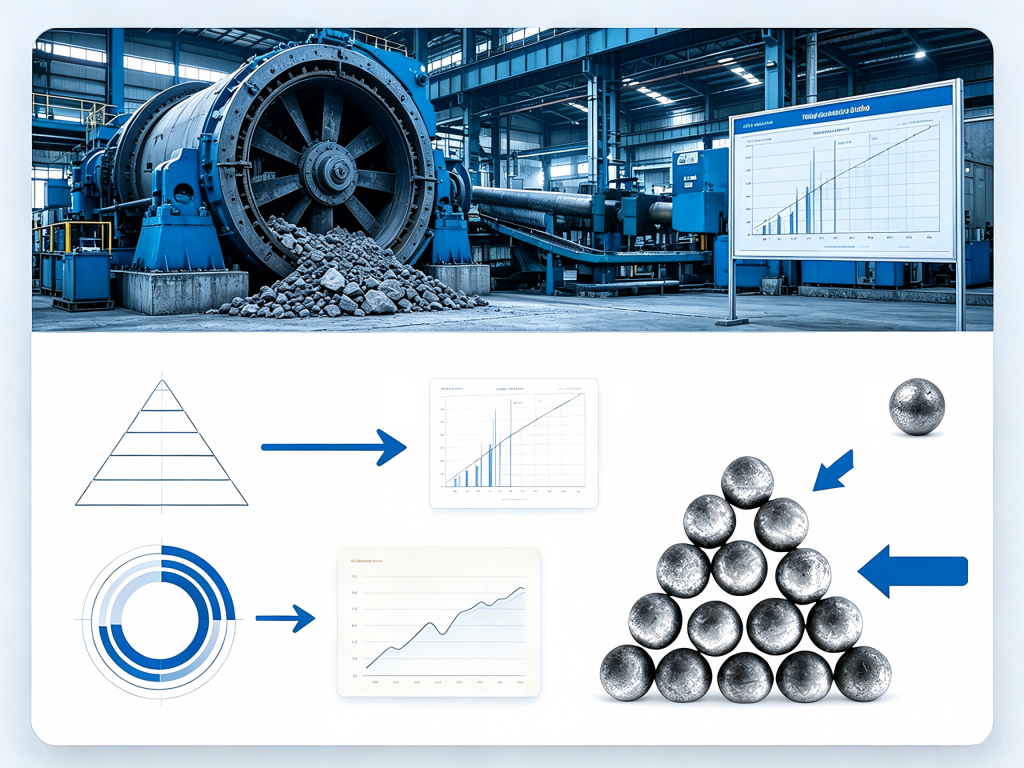
The ball provides a shock, and the ball increases the grinding surface; the grade pair should be adjusted for the grinding particle and target detail.
The size of grinding balls you put into your ball mill directly impacts grinding efficiency, energy consumption, and product quality. Using the wrong ball size wastes energy, causes over-grinding, and increases operating costs. Here’s a practical guide to matching ball specifications to your grinding goals.
The Core Principle: Match Ball Size to Particle Size
The basic rule of thumb is that grinding balls should be approximately three times larger than the largest particle in the feed material. But the full picture involves more than just starting particle size.
Large Balls: High Impact for Coarse Grinding
Large-diameter balls excel at breaking down coarse feed material. Their greater mass generates higher impact energy upon collision, which is essential for fracturing large particles. In semi-autogenous grinding (SAG) mills, where feed size ranges from 200-350mm, balls typically measure 120-150mm in diameter, with some applications using up to 200mm. The high gravitational potential energy of these larger balls creates the impact force needed to crush the ore.
However, larger balls have significantly fewer contact points within the mill, making them inefficient for producing ultra-fine powders.
Small Balls: High Surface Area for Fine Grinding
A charge of smaller balls provides exponentially more contact points than an equal volume of larger balls. This maximizes grinding surface area and makes small balls ideal for final-stage fine grinding and producing nano-sized powders. Research shows that average grinding rates actually increase as media size decreases.
The trade-off is that small balls may lack the individual impact energy to break down larger feed particles, leading to prolonged and ineffective milling.
The Optimized Approach: Graded Ball Loads
Instead of using a single ball size, industry best practice uses a rationed ball load with multiple sizes. Tests show that a properly graded ball load can improve grinding efficiency by up to 60% compared to single-size loads.
Scientific Gradation Examples
-
Laboratory-Optimized Gradation: One study determined the optimal media ratio for a ball mill system as Φ50:Φ40:Φ30 = 28%:28%:44% through grinding kinetics analysis.
-
Industrial Copper Mine Gradation: For an industrial ball mill processing copper ore, the optimal initial ball size distribution was calculated as Φ70:Φ50:Φ40:Φ30 = 15%:25%:35%:25%, giving an average ball diameter of 44.5mm.
-
Patent-Optimized Gradation: A Chinese patent application identified a best gradation scheme of Φ60:Φ50:Φ40:Φ30 = 11.65%:50.11%:28.17%:10.07% for achieving optimal loading, economical material use, and best performance.
A Practical Gold Mine Example
A gold mine replaced its single-size Φ100mm ball charge with a graded system of Φ120mm (15%) + Φ100mm (45%) + Φ80mm (30%) + Φ60mm (10%). This optimized gradation balanced high impact for coarse particles with sufficient surface contact for finer grinding.
Step-by-Step Process for Determining Your Optimal Ball Gradation
| Step | Action | Key Factors to Consider |
|---|---|---|
| 1. Analyze Feed Particle Size Distribution | Screen your feed ore to determine the percentage of material in each size fraction (e.g., +8mm, -8+2mm, -2+0.45mm). | This determines the required ball sizes for each fraction. |
| 2. Match Ball Size to Each Feed Fraction | For each ore fraction, determine the appropriate ball diameter. Example: +8mm → Φ70, -8+2mm → Φ50, -2+0.45mm → Φ40. | The ball proportion for each size should match the percentage of ore needing that impact energy. |
| 3. Calculate Initial Gradation | Sum the proportional ball requirements based on feed distribution. | Your initial charge should reflect the composition of the feed ore. |
| 4. Account for Ball Wear in Operation | As balls wear down to smaller diameters, they continue grinding fine particles but become less effective for coarse material. | Regular monitoring and periodic recharging with larger balls is necessary to maintain the optimal gradation. |
| 5. Consider Mill Parameters | Adjust based on mill diameter, rotational speed (% of critical speed), filling rate (typically 30-50% jar volume), and material density. | Higher density materials (like tungsten carbide) provide more impact force for the same size ball. |
Common Mistakes to Avoid
-
Balls too small for feed: Wasted energy; balls bounce off particles without fracturing them.
-
Balls too large for target fineness: Inefficient and may cause unnecessary contamination from wear.
-
Single-size ball loads: Miss the efficiency gains possible with properly graded media.
-
Ignoring wear dynamics: Without topping up with larger balls, the effective ball size distribution drifts toward smaller diameters, reducing coarse grinding capacity.
Industry-Leading Products from Goldpro
For ball mill applications requiring high durability and precise performance, Goldpro New Materials Co., Ltd. provides specialized grinding balls (Φ20-Φ100mm) developed through extensive failure mechanism analysis and matching heat treatment processes.
Goldpro’s products are designed with a key innovation: high surface hardness (61-63 HRC) with core hardness reaching 58 HRC, ensuring excellent wear resistance within the effective volume. At smaller worn diameters, hardness is appropriately reduced to prevent deformation and out-of-roundness that would otherwise waste mill filling capacity.
In actual use at a large-scale mine, Goldpro’s grinding balls delivered 15-20% reduction in wear, significantly increasing production efficiency while reducing energy consumption. For SAG mill applications (Φ100-Φ200mm), their products are characterized by “three strong and one low”: strong stability, strong impact resistance, strong applicability, and low wear.
Optimize your mill performance with scientifically graded grinding balls. Contact Goldpro to develop the right ball gradation solution for your specific ore characteristics.