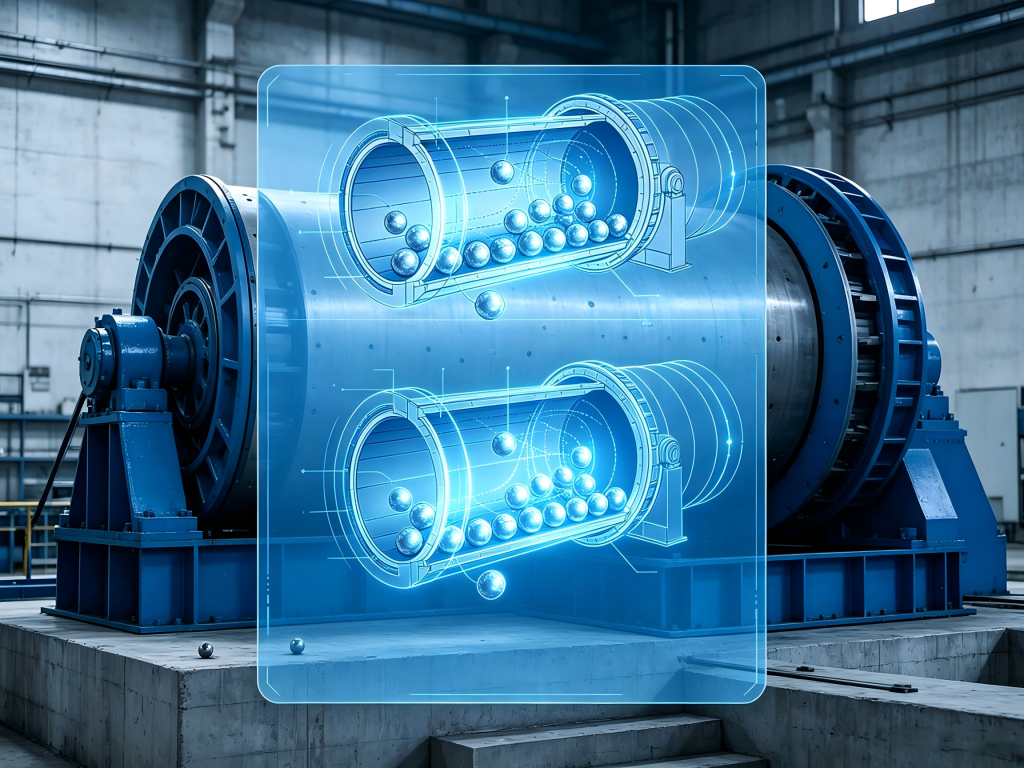
The impact of a depression, fall and centrifugal state is different from that of grinding, and requires a combination of rotation, filling rates and Initial mill fill.
The relationship between the ball mill motor and grinding efficiency is a key factor in operational costs. Inefficiencies often stem not from a single source, but from a combination of how power is delivered, the condition of the grinding media, and the operational parameters of the mill itself.
🔌 Understanding Motor Power & Efficiency Losses
The power displayed on your control system (DCS) is not the power actually used for grinding. Energy is lost at multiple points in the drive train, primarily as heat .
-
Efficiency factors: Losses in the motor itself (typically ~96% efficient) and downstream components like pinion gears (typically ~98.5% efficient) can be multiplied to calculate the total system loss .
-
Real-world example: A 5100 kW reading at the motor input can drop to approximately 4726 kW at the mill shell after accounting for cumulative losses . This means a significant portion of your energy bill doesn’t go into grinding.
-
Technological solutions: Modern variable speed drives and advanced multi-speed motors can significantly improve efficiency by allowing precise speed control and reducing energy waste . One case study showed that adding a变频器 (frequency converter) increased ball mill output by 40 t/h and reduced main motor power consumption by 1.3 kWh/t .
🏗️ The Crucial Role of Grinding Media
The performance of the grinding media is a major variable influencing the motor’s workload and efficiency .
-
Wear & Roundness: As balls wear down, they often become deformed and out-of-round. These misshapen balls create voids in the charge, reducing effective grinding and wasting energy by occupying space within the mill that should be filled with active media .
-
Optimized Hardness: Goldpro has developed grinding balls with high hardness and wear resistance during their effective working life, but with hardness that appropriately reduces at smaller diameters. This prevents excessive deformation, maintaining effective filling rates and improving energy efficiency . This approach has been shown to reduce steel ball wear by 15–20% in actual use .
-
Fill Rate Balance: Increasing the grinding media fill rate is not always beneficial. Research shows that while a higher fill rate (30-35%) increases ball-ore collisions, it also significantly increases energy losses from ball-ball and ball-liner impacts, and accelerates liner wear . Finding the optimal fill rate for your specific ore and mill is essential.
⚙️ Optimizing Key Mill Parameters
Beyond the motor and media, other operational parameters must be tuned for maximum efficiency.
💎 Conclusion
Improving ball mill efficiency requires a holistic approach. Use the correct media for your application (e.g., specially formulated balls for SAG mills with “three strong and one low” properties—strong stability, impact resistance, applicability, and low wear ) and optimize fill rate and speed. For ball mills, choose grinding media designed to maintain shape and minimize wasted filling volume for maximum energy efficiency .